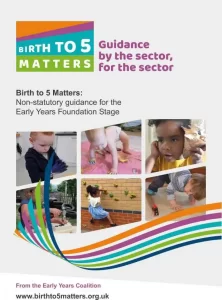
Birth to Five Matters: EYFS Guidance for Early Years Practitioners
Introduction
Birth to Five Matters is non-statutory guidance for the Early Years Foundation Stage. It helps early years practitioners, teachers, childminders and leaders think carefully about children’s learning and development from birth to the end of Reception.
Although it is not a statutory document, Birth to Five Matters can be a very useful tool for settings and schools. In particular, it can support curriculum planning, observation, assessment, staff discussion and professional reflection.
Rather than using the guidance as a checklist, practitioners should use it to support their professional judgement. As a result, it can help teams make thoughtful decisions about provision, interactions and children’s next steps.
What is Birth to Five Matters?
Birth to Five Matters is guidance written by the early years sector for the early years sector. It was designed to support practitioners in understanding child development and implementing the EYFS in a thoughtful and practical way.
The guidance covers children’s development from birth to five and includes information about the areas of learning, the characteristics of effective teaching and learning, and the importance of relationships and enabling environments.
In practice, Birth to Five Matters can help staff reflect on what children already know, what they are beginning to understand, and what support they may need next. Therefore, it can be useful for planning, assessment, staff training and curriculum review.
It is especially helpful when teams want to strengthen their understanding of child development without creating unnecessary paperwork.
Is Birth to Five Matters statutory?
Birth to Five Matters is not statutory. This means that early years providers do not have to use it. The statutory document is the EYFS framework, which sets out the legal requirements for learning, development, assessment, safeguarding and welfare.
However, non-statutory guidance can still be extremely valuable. Birth to Five Matters can help practitioners interpret the EYFS framework and apply it to their own children, setting and context.
For example, a nursery, childminder or school may use Birth to Five Matters to support curriculum planning, staff discussion or assessment. Alternatively, they may use Development Matters or their own curriculum documents.
Most importantly, any guidance should support professional judgement. It should not replace practitioners’ knowledge of the children they work with every day.
How does Birth to Five Matters support the EYFS?
Birth to Five Matters supports the EYFS by helping practitioners think more deeply about children’s learning, development and experiences. It encourages staff to look at the whole child, rather than focusing only on isolated statements or age bands.
For example, the guidance can support observation and assessment by helping practitioners notice what children are showing through their play, communication, relationships and behaviour. It can also help staff think about how the environment and adult interactions are supporting learning.
In addition, Birth to Five Matters can be useful for staff meetings, moderation discussions and curriculum reviews. It gives teams a shared language for talking about children’s development and the quality of provision.
As a result, the guidance can help settings move away from tick-box assessment and towards more meaningful professional conversations.
Birth to Five Matters and curriculum planning
If you would like EYFS training or EYFS consultancy, please contact me.